
What California VINE Covers
California VINE and VINELink are custody-status and notification tools. The Kern research identifies the California VINE state page at vinelink.vineapps.com/state/CA. CDCR's victim-services material says users can track county jail custody status through VINE and can register for notification of a transfer to CDCR. Once a person is in CDCR custody or parole, qualifying victims, family members, or witnesses can use CDCR Form 1707 or e1707 for custody-status notifications.
VINE does not replace KCSO Inmate Information, KCSO Arrest Records, Kern Superior Court records, CDCR CIRIS, BOP, or ICE. It is a notification layer. If a result shows released or not in custody, use that as a lead to confirm with the agency that held the person or the court that ordered the release.
The timing of registration matters. A person who is already gone from the roster may not produce the same practical value as a person who is still in custody and available for an alert registration. For Kern County jail custody, use VINE alongside KCSO's current inmate information and the printable record. For a state-prison case, use VINE or CDCR victim-services registration alongside CIRIS and CDCR Case Records.
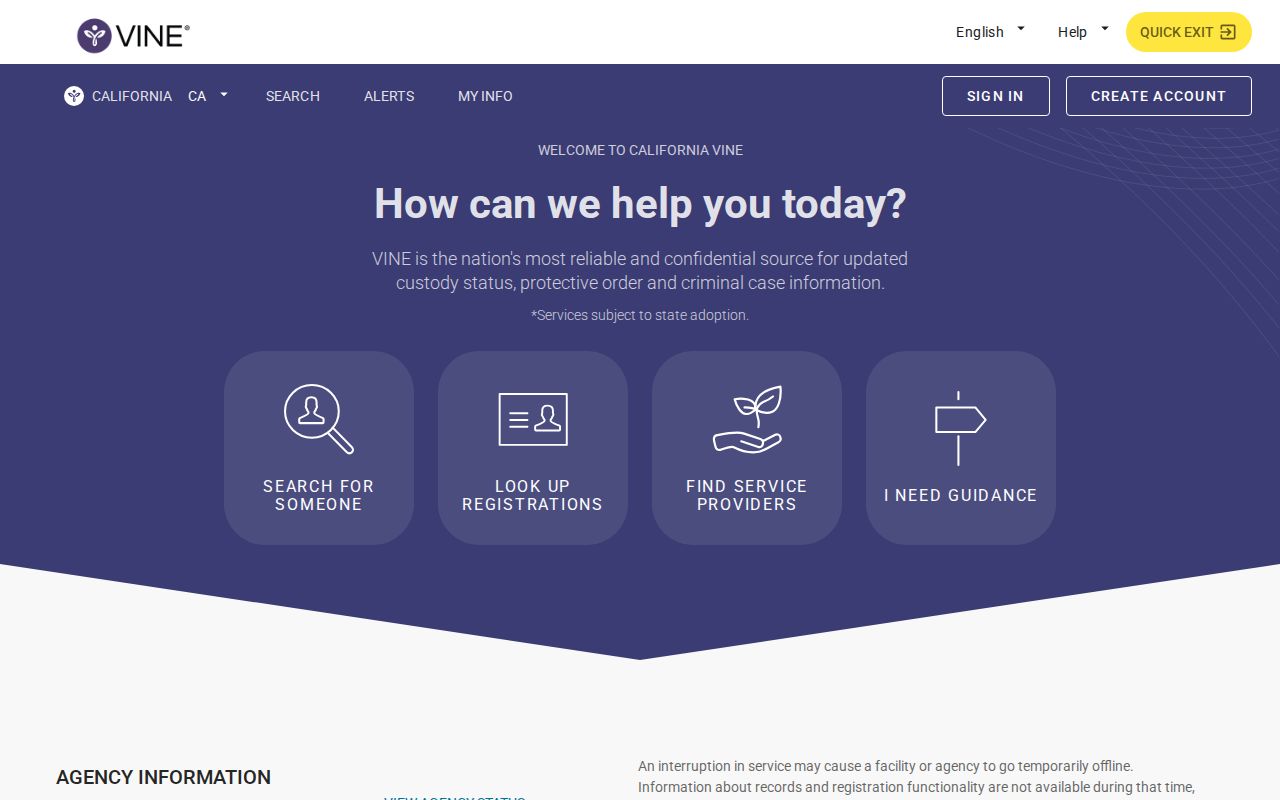
Source context: California VINE is the state entry point for VINELink searches and alerts. The manifest includes the successful screenshot below for this page.
How to Search One Person
Use VINELink when you have a specific person's name or ID and need custody status or a release notification. It is not a complete criminal-history database, not a mugshot database, not a court docket, and not a permanent released-inmate archive.
- Open California VINE or the national VINELink portal and select California.
- Choose a person search rather than a broad agency browse if the interface offers options.
- Search by first and last name. Use offender or inmate ID if you have it because common names can return multiple results.
- Compare the result using facility, agency, birth date or age, and custody status where those fields are displayed.
- If the person appears in KCSO custody, confirm the booking details through KCSO Inmate Information and the printable view.
- If the person appears as a CDCR case, confirm with CIRIS or CDCR victim-services channels.
- If no VINE result appears, search KCSO, Kern Superior Court, CIRIS, BOP, or ICE based on the custody type. A missing VINE result does not prove the person was never in custody.
For Kern County, this means a VINE check may begin with county jail custody at Lerdo Pre-Trial Facility or another KCSO facility, then shift to CDCR if the person is transferred to state prison. Keep the agency name attached to the result so you know who can confirm it.
If there are multiple matches, do not choose based only on name similarity. Compare the agency, facility, age or birth-date field, and any ID shown by the interface. When those fields are not enough, return to the originating system: KCSO for a jail booking number, Kern Superior Court for case information, or CDCR for a CDCR number. A careful match is especially important when a person has moved between county and state custody.
What VINELink May Show
The exact fields depend on the current interface and the agency feed, but the research supports these practical categories. Treat each field as a custody-status clue, not as a standalone legal record.
| VINELink field | How to read it for Kern County |
|---|---|
| Name or person record | Use it only after matching against age, birth date, agency, or ID where available. |
| Agency or facility | Shows whether the feed is from KCSO county jail, CDCR, or another participating agency. |
| Custody status | May show in custody, released, not in custody, or another status depending on the feed and timing. |
| Offender or inmate ID | Useful for exact matching and for later agency contact. |
| Release or custody-change date | May appear for some results, but should be confirmed with KCSO, court, CDCR, BOP, or ICE. |
| Notification options | Used to register for phone, email, text, or other available alerts in the current interface. |
A released result is not the same as a court disposition. The court record may explain whether the person was released on bail, sentenced to time served, placed on probation, transferred to CDCR, or released after a dismissal or other order.
For Kern County releases, the agency field is often as important as the status field. A status attached to a county jail feed should be confirmed through KCSO and the court. A status attached to CDCR should be confirmed through CIRIS, BPH fields where relevant, and CDCR victim-services registration if the user qualifies. A federal or ICE custody question should leave the VINELink workflow and move to the appropriate federal or immigration source.
Register for Release Notification
Register before the expected release whenever possible. VINE is designed to notify users of custody changes, so waiting until after a release may leave only a stale or incomplete result.
- Search for the specific person and open the matching result.
- Choose the notification registration option for the custody-status change.
- Select the contact methods offered by the current California interface, such as phone, email, or text.
- Enter the contact information carefully and save the registration.
- For phone alerts, create or confirm the PIN if the interface requests one. VINE systems commonly use a PIN to confirm receipt and manage calls.
- Keep contact information current. CDCR specifically states that registered users are responsible for keeping contact information current for notification.
- For a CDCR state-prison or parole case, use CDCR Form 1707 or e1707 if the user qualifies for CDCR victim or witness notification services.
CDCR Form 1707 Layer
CDCR's victim-services page says a victim, family member, or witness may request notification of changes to custody status, including release, death, escape, parole hearing, transfer to another prison, discharge from parole, contract, or scheduled execution, by using CDCR Form 1707. The same research says county jail custody can be tracked through VINE and that users can register for notification of an inmate's transfer to CDCR. Once transferred, CDCR online registration through e1707 is available.
That split matters in Kern County because the county contains KCSO jails and several CDCR prisons, including CCI, KVSP, NKSP, and WSP. A KCSO booking release and a CDCR custody-status change are not the same event, and the notification path should match the agency holding the person.
CDCR Form 1707 and e1707 are also narrower than a public search page. They are victim-services notification tools for qualifying registrants, not a general public archive of every release. Use them when the person is in CDCR custody, when a transfer to CDCR has occurred, or when parole and discharge notifications are part of the custody-status question.
VINELink Limits and Confirmation
VINELink is not the final answer for every release. It may lag, may depend on a participating agency feed, and does not replace direct records. It also does not track federal Bureau of Prisons custody or ICE custody as a general VINELink function. When the person leaves Kern County jail for federal or immigration custody, use the BOP inmate locator, ICE ODLS, ICE facility contacts, or records channels.
Confirm the source: Use KCSO for county jail custody, Kern Superior Court for the court action, CDCR/CIRIS for state prison custody, BOP for federal custody, and ICE for immigration detention. VINE can alert you, but the originating agency confirms the official record.
For a named Kern County person, the strongest workflow is to search VINE before release, save the notification registration, then check the official agency page after the alert arrives. If the result is unclear, use the records request or court-record route instead of assuming what happened.
For older releases, VINE may be less useful than KCSO Arrest Records, a CPRA request, or Kern Superior Court records. KCSO's local rule that arrest information is public when the person is currently in custody or the release date is within the past 60 days gives a better recent-record path than trying to use VINELink as a historical search.