
Kern County Parole vs Probation
Parole and probation are not the same record in Kern County. Parole usually follows a California state-prison sentence and is handled by the CDCR Division of Adult Parole Operations, often called DAPO. Probation is usually tied to a county criminal case and a Kern Superior Court order. PRCS, or post-release community supervision, can place a person under county supervision after a prison release when state law assigns that supervision locally.
A released person may also be outside a jail bed but still under KCSO control through Work Release, Electronic Monitoring, or Sheriff's Parole. That makes the first question simple but important: was the person released from the Kern County jail system, from CDCR state prison, from federal custody, or from ICE custody? The answer determines whether the search should start with KCSO, CDCR/DAPO, Kern County Probation, the court, BOP, or ICE.
| Supervision type | Who handles it | Best public verification path |
|---|---|---|
| State parole | CDCR DAPO, with BPH records for suitability cases | Search CIRIS, then check DAPO and BPH hearing results where relevant. |
| County probation | Kern County Probation and the sentencing court | Use the Kern Superior Court case search and probation contacts. |
| PRCS | County supervision after a qualifying prison release | Confirm through court orders, probation records, and CDCR release status. |
| KCSO alternative custody | KCSO Work Release, Electronic Monitoring, or Sheriff's Parole | Confirm through KCSO program records and the sentencing court. |
- Parole
- Supervision after a state-prison release, usually managed by CDCR DAPO.
- Probation
- Court-ordered local supervision that may be ordered instead of, or after, local custody.
- PRCS
- Post-release community supervision handled locally for certain people released from state prison.
- Absconder
- A supervised person alleged to have stopped reporting or left supervision without approval.
Verify Kern County Post-Release Supervision
Kern County supervision checks work best when the search follows the release route. A current jail roster result is not proof of post-release status, and a missing roster result does not prove the person is free of supervision. The Kern County released inmates search path helps identify the custody record first, then the supervision record can be checked with the agency that owns it.
- Start with the release source. Use KCSO records for a local jail release, CIRIS for a CDCR prison release, and the court docket for a probation or PRCS order.
- For a CDCR case, search by CDCR number or name in CIRIS and compare commitment county, current status, parole fields, and release information.
- Check the BPH hearing schedule or results if the case involved parole suitability rather than a routine determinate release.
- For county probation or PRCS, search the Kern Superior Court record for sentencing, revocation, modification, or violation entries.
- If the person is on KCSO Work Release, Electronic Monitoring, or Sheriff's Parole, confirm the program status through KCSO and the court order.
- Use California VINE for custody-change notices, but do not treat it as the full supervision file.
The same name can appear in more than one system. A person could have a Kern County case, a CDCR number, a later parole hearing, and a local probation violation entry. Match dates, case numbers, birth date, facility, and agency before treating a result as the right person.
Note: A released Kern County inmate may be out of custody while still under court, county, or CDCR supervision.
Kern County Parole Office
CDCR's Northern Region directory gives a local Bakersfield parole office for state parole matters. This office is the most specific Kern-area DAPO contact found in the research. It should not be used as a general Kern County Probation roster because probation and PRCS records often start with the sentencing court and local probation contacts.
CDCR DAPO Bakersfield 1, 2, & 3 GPS
3416-A Sillect Avenue
Bakersfield, CA 93308
Phone: (661) 634-9620
Use for: local CDCR parole-office questions after a state-prison release, including DAPO supervision routing.
Kern County also has several CDCR prisons, including CCI, KVSP, NKSP, and Wasco State Prison-Reception Center. A person released from one of those facilities is not being released from the county jail. For those cases, use CIRIS, CDCR records, DAPO, and BPH, then confirm any local court matter separately.
The Kern County Probation Department is the local agency reference point for county probation services, but the public case trail often begins in the Kern Superior Court docket. Probation terms, violations, revocations, and termination dates are court-driven facts.
Kern County Parole Hearing Records
The California Board of Parole Hearings is part of CDCR and handles parole suitability hearings for eligible prison cases. BPH says its hearing schedules include date, time, location, and whether a hearing will be in person or by video conference. The schedule page is updated weekly on Thursday morning, and the results page posts recent weekly and monthly outcomes.
The BPH result terms matter. A grant is a recommendation for release to parole, but it remains subject to later review. A deny result means the person was not found suitable. Continue, cancelled, split, postpone, waive, and stip each describe a different hearing outcome, so the result should be read with the case's CIRIS record and any later CDCR update.
The BPH hearing path is most relevant to people in CDCR custody or CDCR parole processes. A Kern County jail detainee does not get a BPH suitability hearing just because the jail is in Kern County. County probation, Work Release, Electronic Monitoring, and Sheriff's Parole are separate local routes.
The BPH hearing results page is shown in the captured source below.
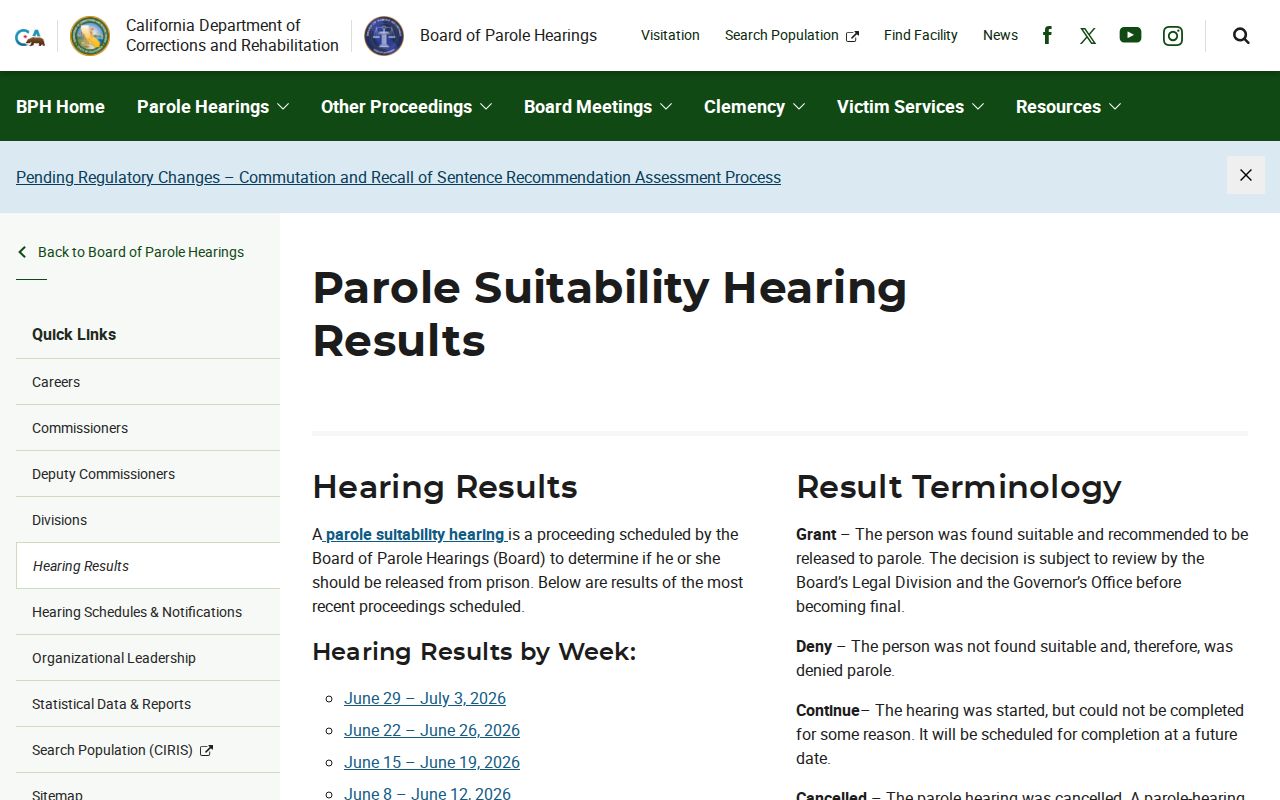
Use the result as a parole-hearing record, then verify release status through CIRIS, DAPO, or the institution records channel.
Kern County Release Supervision Programs
Kern has local release-to-community programs that do not fit neatly into a parole or probation label. The KCSO Work Release Program was established under Penal Code section 4024.2. The research notes that it monitors about 300 participants at a given time and can accommodate more than 500. Completion, termination, or revocation should be checked with KCSO Work Release and the sentencing court.
The KCSO Electronic Monitoring Program and Sheriff's Parole structure cover some people released from jail to GPS or alcohol monitoring. EMP may use home visits, tracking, phone contact, and mail correspondence to monitor compliance. That means a person may be out of a jail bed but still under active KCSO supervision.
Kern County Absconder Limits
Warrant and absconder information has strict limits in Kern County. CDCR's DAPO page includes a wanted-offenders link for sex offenders being sought by DAPO, but that is a narrow state parole channel. It is not a general list of every person with a Kern County probation violation or every person who missed a court date.
KCSO's Arrest Records page says warrant information is not released by phone. It says the subject of the warrant must appear in person at the Kern County Justice Facility Inmate Receiving Center with photo ID to confirm an outstanding warrant. The public or the subject may use court phone paths for felony, misdemeanor, and traffic warrant information, but KCSO does not provide a simple phone lookup for warrant status.
| Status question | Where to start | Limit |
|---|---|---|
| State parole absconder | CDCR DAPO wanted-offender resources | Focused on DAPO's listed wanted sex offenders, not all parole cases. |
| County probation violation | Kern Superior Court and probation contacts | Public details depend on the court record and agency release rules. |
| Outstanding warrant | Court channels or in-person KCSO confirmation by the subject | KCSO says warrant information is not released over the phone. |
Kern County Release Property Rules
Property can matter when someone moves from custody to supervision. KCSO gives different property-release windows for Lerdo Pre-Trial and Max-Med. The research notes that Pre-Trial property releases occur Monday through Friday, 8:00 AM to 5:00 PM. Max-Med property releases occur Monday through Friday, 8:00 AM to 8:00 PM, and Sunday, 8:00 AM to 2:00 PM.
KCSO says inmate clothing will not be released. Money or property can be released to an out-of-custody person with valid photo ID, and processing can take 30 minutes to three hours. These details do not prove parole or probation status, but they help explain why a released person may still need to interact with KCSO after custody ends.
Kern County Supervision Discharge
Supervision ends through a discharge, termination, court order, sentence completion, transfer, or a new custody event. For CDCR parole, DAPO and CDCR records are the key sources, and BPH or CDCR appeal paths may apply if the issue is a parole-discharge report or discharge-review error. For county probation, PRCS, Work Release, EMP, or Sheriff's Parole, the sentencing court and local program records matter more.
A discharge record should be read with the underlying release record. The date a person left jail, the date parole started, the date a probation term ended, and the date a court closed a case can be different dates. When the dates conflict, verify each one with the agency that created it.
Note: VINE can send custody-change notices, but it is not the permanent archive for Kern County supervision history.