
Where KVSP Releases Go
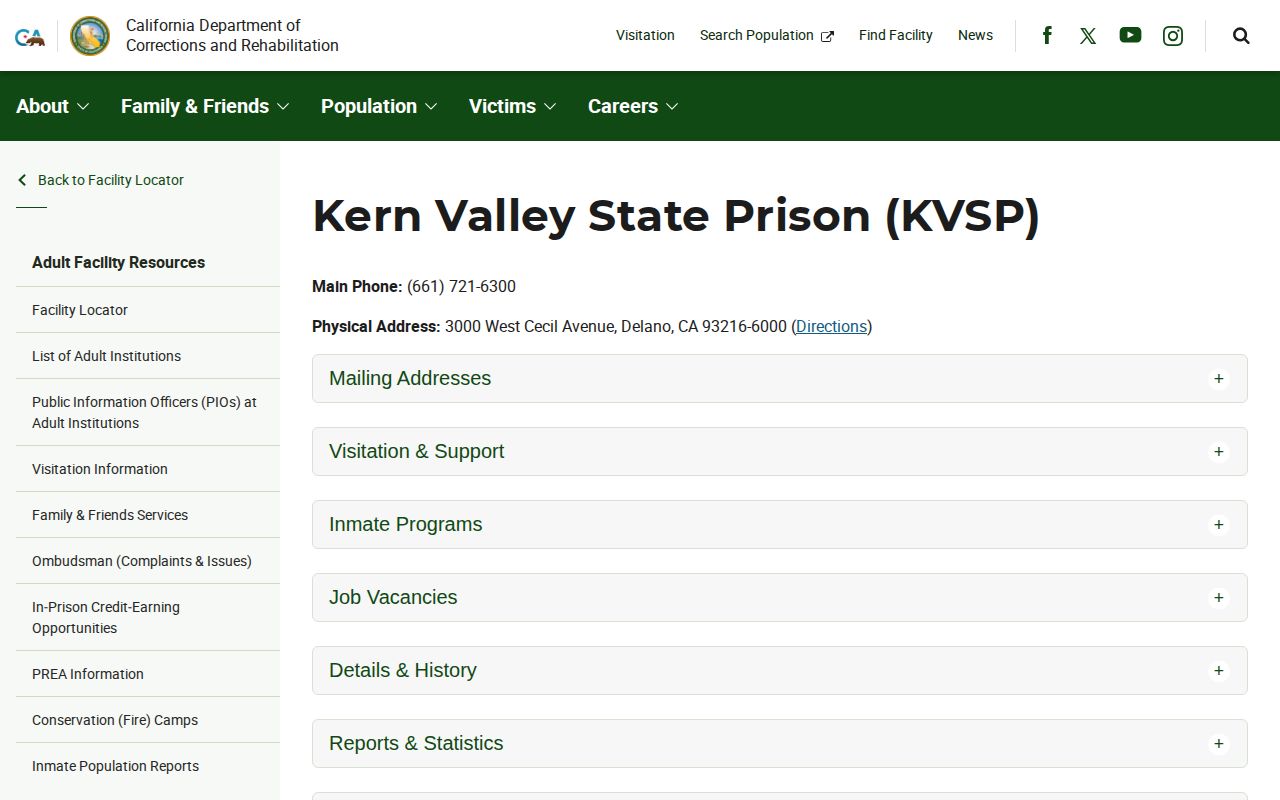
Kern Valley State Prison is operated by CDCR at 3000 West Cecil Avenue in Delano. A person released from KVSP may leave to CDCR parole supervision, discharge from a determinate sentence, a post-release supervision route, a court-ordered resentencing release, or another lawful custody channel. Those events are not county-jail releases even though the prison is physically in Kern County.
The public search path should begin with CDCR's California Incarcerated Records and Information Search. CIRIS is strongest for current CDCR custody and public prison-date information, including identity, CDCR number, current location, commitment counties, admission date, and BPH information where available. If a person is no longer listed at KVSP, the next question is whether they were transferred, released, discharged, or moved into parole supervision.
Do not use the jail roster as the main KVSP search. KCSO can confirm a separate Kern County booking or transfer. CDCR, BPH, DAPO, VINE/CDCR victim notification, and the sentencing court confirm the state-prison release route.
How to Confirm a KVSP Release
The cleanest KVSP workflow is to identify the CDCR record first, then confirm the legal action that ended or changed custody. Use the sentencing court only when you need the court document that CDCR relied on, such as an abstract, amended minute order, or resentencing document.
- Search CIRIS by CDCR number. If the number is unknown, search by name and compare age, commitment county, and current location.
- Note whether the current location is KVSP, another CDCR facility, or no longer shown in a way that requires a records follow-up.
- Check BPH fields or the BPH hearing schedule if the case involves parole suitability.
- Review BPH hearing results for recent weekly or monthly decisions. A grant is not the same as same-day release because additional review may apply.
- Contact KVSP or CDCR Case Records for sentence-computation or release-processing questions.
- Use DAPO to confirm state parole supervision after release, including the assigned parole unit when available.
- Use California VINE or CDCR victim-notification services when advance or custody-change notification is the goal.
When the original case came from Kern Superior Court, the court portal or official court-record request can help verify the sentence, resentencing order, dismissal, or modification. The main Kern County release guide separates this state-prison path from local jail releases, federal releases, and immigration custody.
KVSP Records and Contact
KVSP facility contact is useful for institution-level routing, while official release records may require CDCR Case Records or the relevant statewide office. Use the facility phone when you need the correct internal records or public-information route.
Facility Contact
Kern Valley State Prison
3000 West Cecil Avenue
Delano, CA 93216-6000
(661) 721-6300
Release Contacts
Use CIRIS for the public search, CDCR Case Records for sentence and release processing, BPH for parole-suitability events, DAPO for parole after release, and CDCR public records for formal records.
For identification help, CDCR's public service materials list the Identification Unit at (916) 445-6713. For victim notification, CDCR's victim services office and California VINE are the appropriate channels. For a Kern commitment case, the Kern Superior Court record may provide the court order behind the CDCR action.
About Kern Valley State Prison
KVSP is one of several CDCR prisons located in Kern County. Its Delano address often leads searchers to use Kern County jail tools, but the operating agency is CDCR. That means the release record follows the statewide prison system and any parole or BPH process, not KCSO's 60-day arrest-information rule for county jail arrest records.
CDCR lists prison mailing addresses, public prison information, and staff and inmate mail routes by facility. Those institutional details are useful for contacting KVSP, but the most reliable release confirmation usually comes from the combination of CIRIS, Case Records, BPH, DAPO, California VINE, and the sentencing court.
KVSP Release Fields to Track
A state-prison release is easiest to verify when the same identifiers appear across CDCR, BPH, DAPO, and court records. Do not rely on name alone when a CDCR number, age, commitment county, admission date, or court case number is available.
| Field | Why it matters |
|---|---|
| CDCR number | The most precise identifier for CIRIS, Case Records, and prison correspondence. |
| Current location | Shows whether the person is at KVSP, elsewhere in CDCR, or requires a follow-up for release or transfer. |
| Commitment county | Connects the prison record to the sentencing court, including Kern Superior Court when applicable. |
| BPH date or result | Explains parole-suitability timing and whether a hearing was granted, denied, postponed, waived, or otherwise resolved. |
| Supervision agency | Points to DAPO parole, county PRCS/probation, or another post-release route. |
Photos, Notifications, and Public Information
CDCR media and public-information channels are the more appropriate route for state offender photos or release-action details when CIRIS does not answer the question. KCSO's booking-photo rules are county-jail rules and do not control CDCR prison identification photos.
California VINE and CDCR victim-notification services can help registered users receive custody-change notices. These tools are notification layers, not permanent case archives, so official verification should still come from CDCR, BPH, DAPO, or the court record when the release has already occurred.
Why KVSP Dates Change
A projected release date at KVSP can change for reasons that do not appear in a county jail search. CDCR may need certified court documents, may find another commitment, may identify a detainer, may route the person to parole or PRCS, or may need to complete required notification and release-planning tasks. A BPH grant can also be subject to additional review before it becomes a final release to parole.
California credit rules also differ by case type. Penal Code section 2933 addresses worktime credits for many state-prison determinate sentences, while Penal Code section 2933.1 limits credits for qualifying violent felony cases. Those rules are not the same as county jail credits under Penal Code section 4019. For KVSP, use CDCR and the court sentence rather than trying to calculate the date from the public search page alone.
KVSP Court Record Route
The court record is still useful when it supplies the judgment behind the CDCR term. For a Kern County commitment, Kern Superior Court may have the minute order, abstract, resentencing order, or disposition that CDCR uses. The court's online information is not the certified official record, so formal copies may be needed for a precise sentence or release-processing question.
If the commitment county shown in CIRIS is not Kern, the records request should go to that sentencing court. KCSO should only be used for a separate local booking, county release, or transfer entry.